Read this first. I built JustAPI — I'm Swadhin Biswas — with agentic AI as a guide: AI helped me design, implement, debug, and document a large part of this project. I am not claiming this is the best framework in the world, and I am not claiming every number here was measured on your hardware. I am describing what I built, why I built it, what I verified, and — just as important — what I tried that did not work. The documentation site is large, much of it written with AI assistance, and not everything in it is independently verified. If you find a claim that seems wrong, it probably is. Verify it, and open an issue.
What this article is: a technical write-up. What it is not: marketing.
1. What JustAPI is
JustAPI is a Python web framework where the web server, the router, the TLS termination, the request validation, the JSON serialization, and the database access all run in Rust. Your Python code handles the application logic. That is the entire premise, and it is the one sentence that explains every design decision in the project.
from justapi import JustAPIApp

app = JustAPIApp()

@app.get("/")
def hello():
    return {"Hello": "World"}

app.run()   # a real server, not a dev server
That is a complete program. It gives you HTTP/1.1 and HTTP/2, TLS, routing with
path and query parameters, JSON serialization, automatic OpenAPI docs at
/docs, and a server that does not need uvicorn or gunicorn. All of it runs in
Rust. The Python process just runs your handler.
The package is on PyPI (pip install justapi), it works on Linux, macOS, and
Windows, and there are wheels for the free-threaded build of CPython 3.14t.
2. Why I built it (the story)
The starting point was a simple observation that most Python web frameworks treat as a given: the framework runs in Python. FastAPI runs on Starlette, Starlette runs on uvicorn, and uvicorn is a Python event loop with a lot of asyncio machinery between the socket and your handler. Robyn and Granian moved the server to Rust, but the request still crosses into Python for routing, validation, and serialization.
I asked a different question: what if almost nothing crossed into Python? What if the framework — the thing that does the same work on every request — lived entirely in Rust, and Python only ran the code that is different for each application?
That question shaped a project with an unusual constraint, which I wrote down early and enforced throughout: if a feature can be implemented in Rust, it must be implemented in Rust. Not "can be implemented faster in Rust" — can be implemented in Rust. Python in the framework is reserved for the parts that have to be Python: the glue between Rust values and your handlers.
I did not do this alone. I worked with agentic AI throughout — using it as an engineering guide. I made the architecture decisions; the AI helped me turn them into working code, find the bugs I could not see, write the tests, and keep the project honest when I wanted to skip the boring parts. There are parts of this codebase I understand completely, parts I understand well enough to maintain, and parts the AI wrote that I reviewed and tested but would be lying if I said I could reproduce from memory. I am not hiding that; it is part of how this project exists.
The project then went through the standard engineering motions, in order:
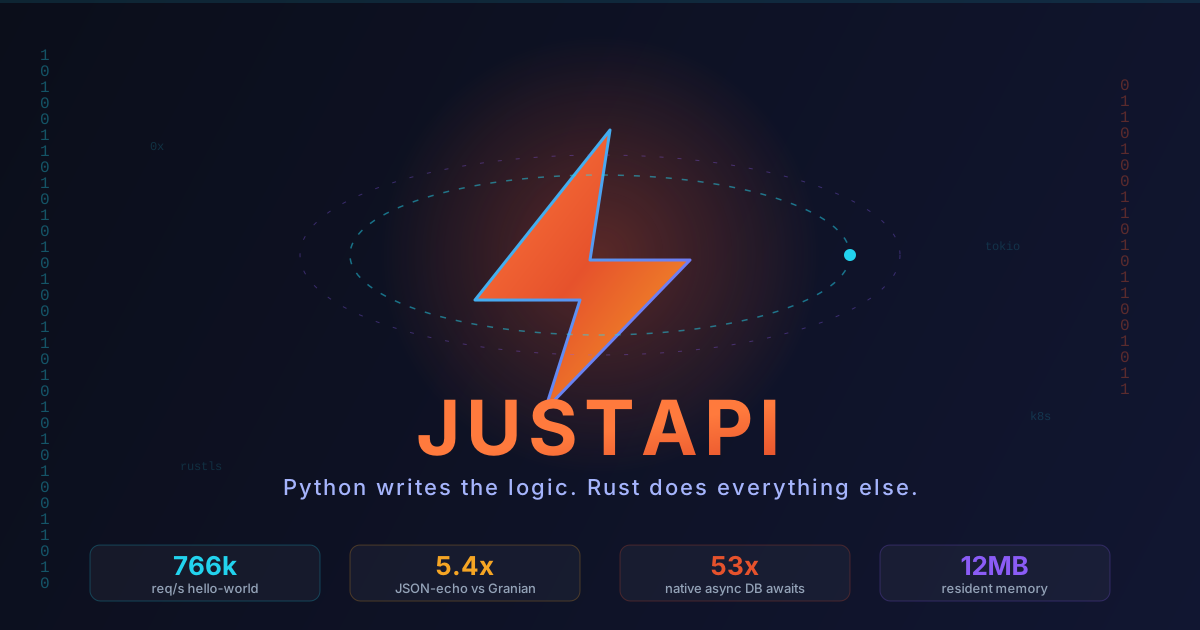
- A minimal server: tokio + hyper, a PyO3 boundary, one route. Measured 766k req/s on the hello-world fixture.
- A native router (matchit radix trie, 51ns average lookup on 500 routes).
- A memory pipeline (per-request arena, buffer pools).
- Middleware in Rust: CORS, security headers, JWT, rate limiting.
- Serialization in Rust (serde_json, optional simd-json).
- TLS with rustls — no OpenSSL dependency.
- A native API surface, replacing the ASGI shim.
- Database access via sqlx: SQLite, PostgreSQL, MySQL, DuckDB.
- WebSockets, SSE, background tasks, a scheduler, a plugin system.
- Operational tooling: OpenTelemetry, Prometheus metrics, health checks, circuit breakers.
None of this was fast in the sense of "one weekend." It was fast in the sense of "the numbers are in the repo, the tests pass, and the failures are documented."
The release history tells part of the story on its own:
| Version | What changed |
|---|---|
| 2.0.8 | Multi-threaded tokio server, free-threaded CPython support, async handler fix (14× async throughput) |
| 2.0.9 | Native async DB awaits, Rust-native SSE, type stubs, tokenless CI publishing, first PyPI release |
| 2.0.10 | The CLI shipped in the wheel (it was a stub before) |
3. The architecture
The request path is a pipeline, and almost every stage is Rust:
Kernel (epoll/io_uring)
  → tokio connection manager (multi-threaded)
  → TLS (rustls)
  → HTTP parse (hyper)
  → Router (matchit, ~51ns lookup)
  → Middleware chain (auth, CORS, rate-limit, compression)
  → Python boundary (zero-copy PyO3, GIL pool)
  → Your Python handler
  → Rust serializer (serde_json / simd-json)
  → Response write → socket
The crate layout mirrors the pipeline:
justapi/
├── crates/
│   ├── justapi-core/       # networking, routing, middleware, serialization, DB pool
│   ├── justapi-py/         # PyO3 bindings + the Python package
│   ├── justapi-cli/        # the `justapi-cli` binary (serve, create, check, profile)
│   └── justapi-bench/      # benchmark harness
├── python/justapi/         # pip-installable package (maturin-built)
├── BENCHMARKS.md           # append-only performance ledger
├── DECISIONS.md            # ADR log (ADR-001 through ADR-093)
└── PLAN.md                 # roadmap with an honesty status on every phase
The dependency graph is intentionally small:
justapi-cli  → justapi-core
justapi-py   → justapi-core
justapi-bench → justapi-core
4. The numbers (verified, with the hardware caveat)
All numbers below are from BENCHMARKS.md, measured on a single machine with
100 concurrent connections and 30-second runs. Your machine will differ.
What matters is the ratio on the same hardware, not the absolute numbers.
| Framework | Hello-world req/s | JSON echo req/s | p99 hello-world | RSS |
|---|---|---|---|---|
| JustAPI (native fast path) | 766k | 782k | 0.48 ms | 12 MB |
| Granian (ASGI) | 314k | 145k | 0.74 ms | 37 MB |
| Robyn | 39k | — | — | — |
| FastAPI + Uvicorn | 36k | 33k | 24.63 ms | 29 MB |
The "native fast path" needs two things: a route registered with native=True
and a Schema. In that configuration, Rust validates the body and writes the
response — Python never runs. Without a schema, you get the Python handler
path, which is GIL-bound at roughly 60–120k req/s on this hardware, same as any
other Python framework.
Other verified numbers:
- Route lookup: 51ns average on a 500-route table.
- Native CRUD SELECT: 181k req/s — 125× FastAPI on the same SQLite fixture.
- Native async DB awaits: 320 RPS vs 6 RPS for the blocking path on a slow query (a 2M-row recursive CTE) — 53×.
- Multi-worker prefork (
justapi serve --workers 4): 1.88× throughput (99.7k RPS vs 53k). - Free-threaded CPython 3.14t, CPU-bound Python handler: 12.4× vs GIL-locked — the GIL ceiling disappears.
What I do not claim: there is no "beats every framework on every
workload" claim here. Light async handlers (no I/O, just asyncio.sleep) sit
at 4–12k req/s — the asyncio loop floor — and I measured that Granian's
direct loop dispatch is faster on that specific shape. I do not hide it; it is
in the benchmarks and in the article below.
5. The async story: what I tried, and what the measurements said
This is the most important section in this article, because it is where I spent the most effort proving myself wrong.
The initial async path was bad. An async handler doing await asyncio.sleep(0.001) served about 808 RPS — a hard ceiling, not
contention. The single GIL worker was blocking on each coroutine's full
duration, serializing every async request. Fixing that (ADR-083) took async
throughput from ~800 to 11,758 RPS — 14× — by making completion
callback-driven instead of blocking.
Then I got ambitious. The plan was: "make the awaits Rust-native." If a
Python coroutine's await could complete on tokio instead of on the asyncio
loop, per-await overhead would drop, and I would beat Granian on async.
I built four approaches and measured every one:
| Approach | Per-await overhead | Verdict |
|---|---|---|
future_into_py (Rust future wrapped as an asyncio.Future) |
2× slower than asyncio.sleep |
The wrapper + cross-runtime wakeup costs more than the loop's own timer |
into_future (coroutine → Rust future) |
tied at best | Requires a running asyncio loop for task-locals; does not decouple |
| Hand-rolled driver, GIL attach per await | ~1125 µs/await | Thread-state setup dominates |
| Hand-rolled driver, persistent thread | ~3.4 µs/await solo | 86× worse concurrent (thread per coroutine) |
| asyncio loop (status quo) | ~45 µs/await | The only mechanism that scales |
The multiplexing driver — one persistent Rust thread stepping many coroutines,
the design that should have worked — measured 16 µs/await vs asyncio's
0.56 µs/await on pure stepping (ADR-091). The absolute floor, a bare
await noop() in asyncio, is 0.039 µs.
The conclusion, written into the ADR log: the Python coroutine send()
stepping is the irreducible floor, and asyncio already runs it at the minimum
possible rate. Any Rust wrapper around send() adds overhead; it cannot
subtract it. A multi-loop dispatch experiment (ADR-092) also came back
neutral-to-worse: the GIL worker is the single dispatch point, so extra loops
only added GIL contention.
I stopped. That is the part of engineering nobody writes articles about: the work you delete. The async path stays on asyncio, which is the right answer, and I went back to making the operations native instead of the coroutine.
6. Native operations: where the real win is
Since I cannot make Python coroutines faster, I made the framework operations they await faster — by taking Python out of them.
Native async DB awaits (query_async). A normal async handler doing a
database query would block the asyncio loop thread for the whole query. One
slow Postgres query froze every other async handler on the server.
await app.db.query_async(...) runs the SQL on the DB's own multi-threaded
tokio runtime with the GIL released. The loop is never blocked. Measured: 53×
faster than the blocking path on slow queries, and it is the only path that is
safe for real databases with network latency.
Rust-native SSE (sse_native). A stream of events is generated entirely
in Rust — tokio timers, an mpsc channel, the HTTP layer drains it. Zero Python
per event. 100k events stream instantly.
@native_async. A marker that routes async handlers to the fastest
dispatch path, and on free-threaded CPython enables true parallel dispatch
across workers.
The pattern is consistent: Python declares the operation, Rust executes it, and nothing in the middle is Python.
7. Bugs I found in my own framework (and fixed)
The honest part of any framework article is the bug list. Some highlights:
Write-path collapse. Concurrent Python-handler writes dropped to ~3 RPS at 11 connections (from ~150 at 10). The request-scoped auto-transaction was double-acquiring pool connections — 2N for N writes. Removed. (ADR-080)
GIL pool not fork-safe. A forked child inherited the parent's initialized GIL pool whose worker threads did not exist, so every Python request hung and returned 504s. The pool now tracks its PID and rebuilds after fork. This was also the root cause of a long-standing flaky test. (ADR-081)
Pydantic models as body_schema were broken. validate_body treated a
Pydantic model class as a plain callable and invoked
BaseModel(body_dict), which raised TypeError. This broke the single most
important FastAPI migration path. Fixed by validating through
model_json_schema() in the Rust engine. It shipped fixed in 2.0.9.
app.run() required an address. The README quickstart showed
app.run() with no arguments, which crashed with a TypeError. Now defaults
to 127.0.0.1:8000.
The CLI in the wheel was a stub. The PyPI package's justapi command
printed a help message and did nothing else. It shipped fixed in 2.0.10
(serve, create, check, openapi — and it delegates to the Rust CLI when
installed).
Unix-only APIs were not cfg-gated. UnixListener-based functions failed
to compile on Windows. Gated with #[cfg(unix)].
Each of these is in the changelog with the commit that fixed it. None of them was found by reading the code. They were found by running things, by benchmarking, and by trying to use the framework the way a user would.
8. What JustAPI ships that no other Python framework ships
- HTTP/3 (QUIC) — feature-gated, serves Python handlers over QUIC through the full native pipeline. As far as I know, the only Python framework with a working HTTP/3 transport.
- Free-threaded CPython wheels (3.14t) with auto-detected parallel dispatch.
- Rust-native SSE where the stream never touches Python.
- Multi-worker prefork with auto-scaling built into the CLI.
- OIDC trusted publishing — the release pipeline uses zero tokens; a tag push builds 9 platform wheels and publishes them.
9. The honest caveats (read this before using it)
The documentation site is large and much of it is AI-written. I generated a lot of the docs with AI assistance. I verified the code and the benchmarks; I did not independently verify every sentence in every doc page. If you rely on a doc page, test the behavior yourself. Some doc pages were already found to describe APIs that did not exist, and I fixed them as I found them. There are probably more.
The LLM/inference features are unverified. Phases 41–52 of the roadmap (inference engine, KV cache, continuous batching, OpenAI-compatible server) are implemented but were never run with real GPU weights. The only honest status is "implemented, not verified." They are not part of the release story, and I do not make performance claims about them. (ADR-067)
The absolute numbers are from one machine. Ratios matter; absolutes depend on hardware, OS, and load generator.
The roadmap contains 17 "implemented but unverified" phases. I mark them 🟡 in PLAN.md. That is not a typo. It means: code exists, tests pass, and the real-world claim is not proven.
Async light handlers are loop-bound. If your handler is
await asyncio.sleep(0.001); return {}, JustAPI is not faster than Granian. I measured it. Use the native operations for DB/SSE/IO work.There is no 1M RPS claim here. The roadmap phase title once said "1M RPS tuning." I never measured 1M RPS. I changed the status to reflect that. (The phase overclaims; I say so in PLAN.md.)
First impressions matter, and mine were rough. The first published CLI was a stub.
app.run()crashed without an argument. The docs had fabricated API references. All fixed, but if you are evaluating the project, the version history is honest about the rough edges.
10. How to actually use it
pip install justapi==2.0.10
# main.py
from justapi import JustAPIApp, native_async
from pydantic import BaseModel

app = JustAPIApp()
app.set_database("sqlite://app.db")

class Item(BaseModel):
    name: str

@app.get("/")
def root():
    return {"Hello": "World"}

@app.get("/items/{item_id}")
async def get_item(item_id: int):
    return await app.db.query_async(
        "SELECT * FROM items WHERE id = ?", [item_id])

@app.post("/items", body_schema=Item)
def create(request):
    data = request.json()
    return app.db.execute(
        "INSERT INTO items (name) VALUES (?)", [data["name"]])

# Rust-native SSE: no Python per event
app.sse_native("/events", count=1000, interval_ms=0)

app.run()   # defaults to 127.0.0.1:8000
Then:
python main.py
justapi check main.py        # validate routes without serving
justapi serve 0.0.0.0:8080   # or use the CLI
For the high-performance Rust CLI:
cargo install justapi-cli # provides serve --workers N --reload, create, profile
11. Where to verify everything in this article
| Claim | Source |
|---|---|
| Benchmarks, methodology, hardware | BENCHMARKS.md in the repo |
| Architecture decisions (all 93) | DECISIONS.md — ADR-001 through ADR-093 |
| Roadmap status incl. unverified phases | PLAN.md (the honesty key is at the top) |
| Async experiments and their failure | ADR-090, ADR-091, ADR-092 |
| Native async DB awaits | ADR-093 |
| Bug fixes | CHANGELOG.md (2.0.8 → 2.0.10) |
| Code | https://github.com/swadhinbiswas/JustAPI |
| Docs | https://justapi.pages.dev |
12. The thing I actually learned
The takeaway of this project is not "Rust is faster than Python." Everyone knows that. The takeaway is more specific and more useful:
The performance of a Python web framework is decided by how much Python runs per request — and the parts you cannot remove, you should not try to make faster by rewriting them in Rust.
I tried to make asyncio faster by moving it to Rust. The measurements said no. I made the operations around asyncio native instead, and that worked: 53× on slow database queries, 125× on native CRUD, zero-Python SSE. The framework's job is to decide which parts of a request are yours and which are the framework's — and then to make the framework's parts not run Python at all.
That, and the discipline to write down the failures, is what JustAPI is.
There is a second lesson, specific to how I built this: agentic AI is a force multiplier, not a substitute for judgment. The AI guided me through Rust lifetimes, PyO3 FFI, and tokio internals I had never touched before. It also wrote things that were wrong, and I only caught them because I benchmarked, tested, and read the output. Use the tool; verify the work.
Written by Swadhin Biswas, maintainer of JustAPI, with agentic AI as a guide. Corrections welcome — open an issue at https://github.com/swadhinbiswas/JustAPI/issues. If a number here disagrees with your measurement, your measurement wins.

No comments yet.